Blogs
July 29, 2026
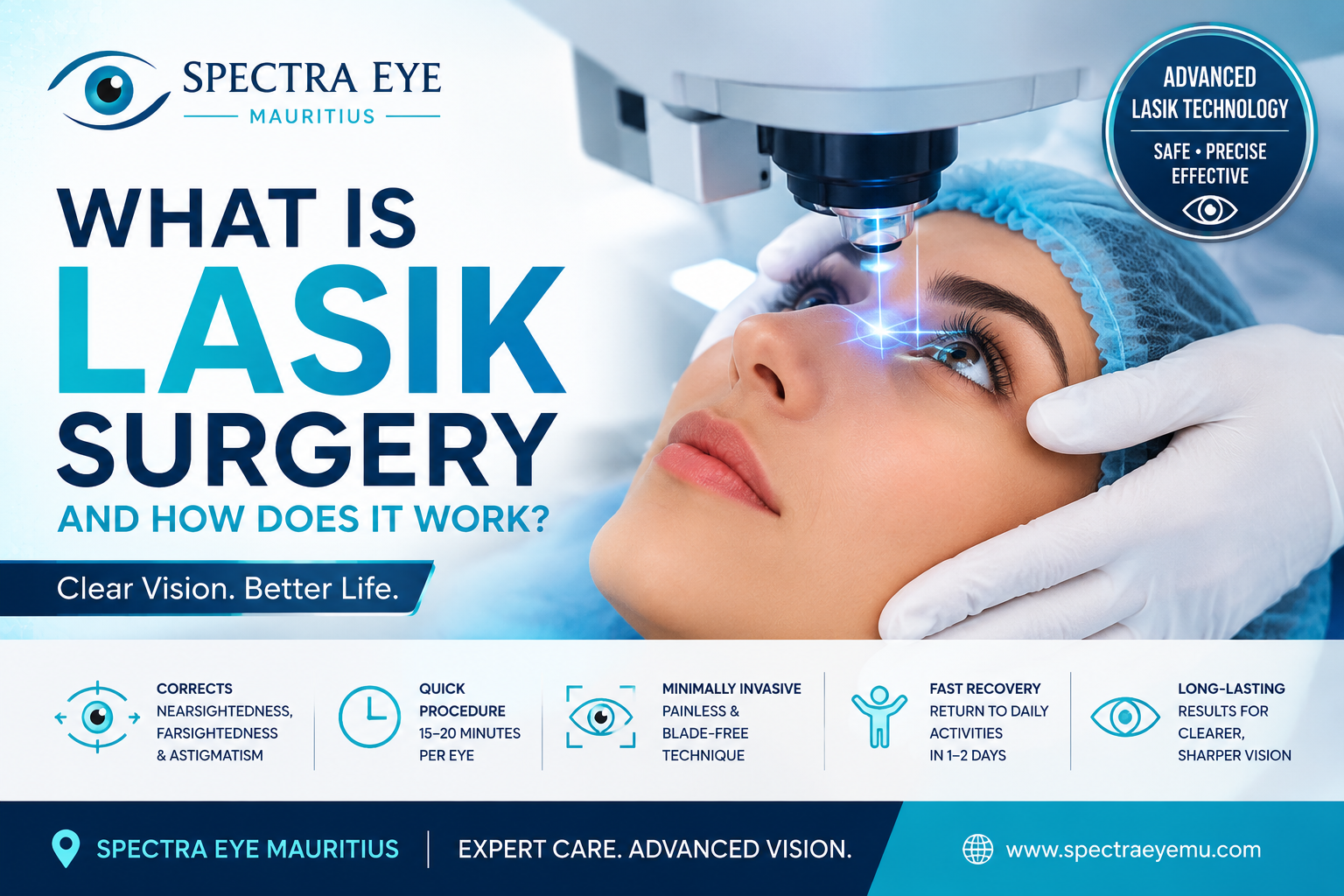
What Is LASIK Surgery and How Does It Work? | Spectra Eye Mauritius
For countless individuals across the globe, beginning the day with blurry vision is a very common experience. The quick act of putting on one's glasses beside the bed, or even putting on contact lenses, becomes a tiring, mundane chore of life. However, advances in modern-day ophthalmology have made things easier, with laser eye surgery becoming a liberating choice.
Of these surgeries, LASIK is the one surgery that is considered the most popular and common. Yet, what is this procedure, and how does it work? Here we explain everything about this revolutionary technique, its process, and what to expect during LASIK surgery in Mauritius.
What is LASIK Surgery?
LASIK means laser-assisted in situ keratomileusis. Simply put, LASIK is a type of surgical procedure that is aimed at correcting vision problems through reshaping the cornea, which is the transparent dome at the front part of your eye.
If there are some deformities in your eye shape, light passing into the eye will not fall on the retina correctly. This leads to vision problems which are called refractive errors.
. LASIK targets and corrects three primary types of refractive errors:
- Myopia (Nearsightedness): This occurs when your cornea is too curved or your eyeball is too long, causing light rays to focus in front of the retina instead of directly on it. Distant objects appear blurry.
- Hyperopia (Farsightedness): This happens when the eyeball is too short or the cornea is too flat. Light focuses behind the retina, making close-up objects difficult to see clearly.
- Astigmatism: Caused by an asymmetrical, football-shaped curvature of the cornea, astigmatism leads to overall blurry or distorted vision at any distance.
In order to accomplish accurate correction by means of the reshaping of the cornea with the help of laser energy, LASIK ensures that the entering light is accurately focused on the retina of the eye.
How Does LASIK Work? The Science Behind the Sight
In order to know how LASIK works, it is important to first understand the structure of the cornea. The cornea is made up of various layers, namely the outermost epithelial layer and the thicker layer below it known as the stroma.
The basic principle of how LASIK works revolves around changing the microscopic structure of the stroma. It all starts with an ophthalmologist’s consultation and comprehensive mapping of the eyes where your eye will be mapped out. In the operation itself, a computer-driven excimer laser fires ultraviolet rays to remove microscopic amounts of tissue in the stroma.
- To correct nearsightedness, the laser flattens a cornea that is too steep.
- To correct farsightedness, the laser steepens a cornea that is too flat.
- To correct astigmatism, the laser smooths out an irregular cornea into a more symmetrical shape.
The Step-by-Step LASIK Eye Surgery Procedure
Understanding the actual lasik eye surgery procedure can significantly alleviate any anxiety you might feel about the treatment. It is a quick, outpatient process that typically takes less than 10 to 15 minutes for both eyes.
Step 1: Numbing and Preparation
When you arrive at the clinic, you are guided to a reclining surgical chair. The medical team applies specialized anesthetic numbing drops directly to your eyes. This ensures that you remain completely comfortable and pain-free throughout the entire procedure. A gentle device called a lid speculum is placed to keep your eyelids open, preventing you from blinking.
Step 2: Creating the Corneal Flap
The surgeon begins by creating a microscopic, thin, hinged flap on the surface of your cornea (the epithelium). In traditional LASIK, this is done using a precise mechanical instrument called a microkeratome. However, advanced clinics now regularly utilize Bladeless LASIK (or Femto-LASIK), which employs a ultra-fast femtosecond laser to create the flap with exceptional structural precision.
Step 3: Laser Reshaping
Once the flap is formed, the surgeon gently folds it back to reveal the underlying stromal tissue. You will be asked to look at a steady fixation light for a few seconds. The surgeon then activates the excimer laser. As the laser pulses, it gently removes the pre-calculated microscopic tissue layers to reshape your cornea. You might hear a rhythmic clicking sound, but you will not feel any pain.
Step 4: Repositioning the Flap
After the laser work is complete, the surgeon gently folds the corneal flap back into its original position. The natural properties of the corneal tissue allow the flap to adhere secure and flush without the need for any surgical stitches or sutures. The healing process begins almost immediately.
Why Choose Spectra Eye Hospital in Mauritius?
For those who want laser eye surgery information from top-notch specialists right in your area, Spectra Eye Hospital in Ébène, Mauritius, is a perfect institution. With top-notch eye specialists, this institution provides latest technology and high-quality diagnostic techniques on the island.
The patients at Spectra Eye Hospital get an extensive ophthalmological consultation and structural diagnosis to identify the individual ocular features. It guarantees that your treatment technique, whether traditional LASIK, Bladeless Femto-LASIK or any other procedure such as PRK or SMILE matches your corneal thickness, lifestyle demands, and health profile.
FAQ
However, no, the actual process of LASIK does not hurt. Before the operation starts, the eye specialist will place very effective anesthetic drops into your eyes that will prevent you from feeling any pain. The creation of the corneal flap can cause some temporary feeling of pressure that will disappear in a few seconds. Postoperatively, it is normal to have some dry feeling that will last for several hours, which can be easily relieved with eye drops prescribed by the specialist.
The first stage of recovery following LASIK surgery takes an amazingly short time. Within 24 to 48 hours of the treatment, most patients will have already experienced a considerable improvement in their vision. Although most people are able to go back to work the day after the surgery, their vision will still improve during the coming days and weeks. Your physician will give you a schedule of regular follow-up visits.
The traditional LASIK procedure requires the use of an extremely accurate blade, called a microkeratome, to cut the required thin flap from the surface of the cornea. On the other hand, in case of bladeless LASIK (Femto-LASIK), the blade is replaced entirely by the use of a specially designed femtosecond laser that forms the flap.
While LASIK surgery is suitable for many individuals to become visually independent, perfect patients must be 18 years or older, should have their eyesight prescriptions stable for a year, and must have healthy eyes with no serious corneal problems. People with very thin cornea or those suffering from some kinds of dry eye problem may benefit more from other types of vision correction procedures like PRK or SMILE.
It will be simple for you to get an eye examination and LASIK testing done at Spectra Eye Hospital Mauritius. The hospital has a state-of-the-art infrastructure, and it can be found in the GFin Building, in Ébène. It will be easy for you to contact their professional team via email.


